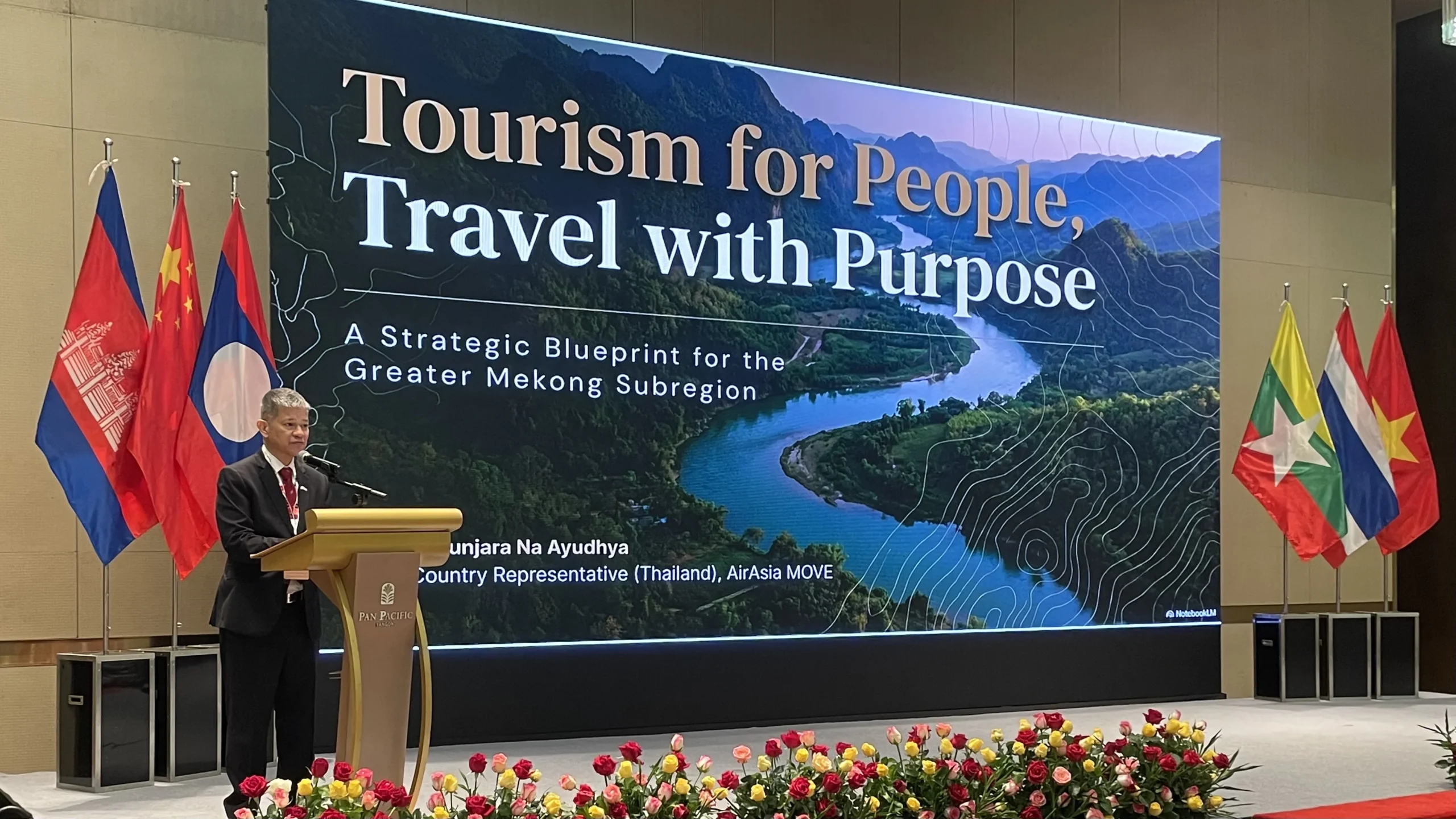
YANGON — The travel industry must stop measuring success purely by visitor arrivals and instead focus on the value tourism creates for local people, cultures, and destinations, according to Chattan Kunjara Na Ayudhya, Head and Country Representative (Thailand) for AirAsia MOVE. Speaking at the Mekong Tourism Forum 2026, held 16–18 June in Yangon, the veteran of 37 years at the Tourism Authority of Thailand (TAT) challenged tourism leaders, policymakers, and destination managers from across the Greater Mekong Subregion (GMS) to rethink their core metrics.
Under the forum theme “Tourism for People, Travel with Purpose,” Chattan argued that traveler expectations have fundamentally shifted. “The modern traveler no longer simply wants to see the world,” he said. “They want to connect deeply with it, understand it, and ultimately leave it slightly better than they found it.” He noted that the COVID-19 pandemic accelerated this change, reminding both travelers and destinations of tourism’s fragility. “Who would have thought that the tourism industry would collapse during COVID? We learned that tourism cannot be taken for granted. Travelers returned with a greater appreciation for places, people, and experiences.”
From Arrivals to Impact
Chattan directly challenged the industry’s long-standing reliance on visitor numbers as the primary success metric. “Increasing arrivals is important,” he said. “But extending length of stay and increasing local spending often creates far greater benefits for communities.” He illustrated this with a personal example: as a self-described food enthusiast, he is willing to travel beyond major cities to discover a single local dish. That extra journey generates spending on local transportation, restaurants, accommodation, and small businesses, spreading tourism benefits beyond traditional hubs. “Sometimes the most valuable visitor is not the one who visits the most places,” he said. “It is the one who stays longer, spends locally, and connects more deeply with the destination.”
This shift aligns with broader trends in wellness tourism and purpose-driven travel, where deeper engagement and personal growth are increasingly valued over sightseeing volume.
Authenticity Under Threat
A recurring theme was the need to protect authenticity as tourism grows. Chattan warned against commercializing destinations to the point where they lose the qualities that attracted visitors. Recalling work with a rural tourism community in Thailand, he described how a successful homestay destination replaced traditional character with facilities designed for mass tourism. Visitors quickly noticed. “This is not what they travelled for,” he recalled hearing from disappointed guests. “People come looking for authenticity, not a copy of something they can find anywhere else.” He posed a critical question for tourism planners: “How do we scale hyper-local slow travel across the GMS without destroying the very authenticity we are trying to promote? That is a question we should continue asking ourselves.”
Communities at the Center
Chattan stressed that local communities must remain at the heart of tourism development. Drawing on his experience helping reopen destinations during the pandemic, he described how community consultation became essential. Rather than imposing solutions from above, local residents were asked whether they wanted visitors to return and under what conditions. “This is their home,” he said. “Communities know best what is right for their destination. They should have a voice in shaping its future.” He encouraged governments and tourism organizations to invest in community-based tourism, local entrepreneurship, workforce training, and digital platforms that connect travelers directly with local experiences. “Technology should not replace human interaction,” he said. “It should help create it.”
This community-first approach is echoed in recent research on hospitality skills gaining value as AI reshapes travel workforce needs, where human connection remains irreplaceable.
A Simple Lesson from Yangon
One of the most memorable moments came from a brief encounter during Chattan’s first day in Myanmar. While visiting the Shwedagon Pagoda, he purchased an admission ticket and was greeted warmly by the seller. “She handed me the ticket and said, ‘Welcome, brother.’” The story drew smiles from the audience and reinforced his central message. “That brief interaction stayed with me,” he said. “It was genuine, it was authentic, and it reminded me that hospitality is ultimately about human connection.” For Chattan, that simple exchange represented the true value of travel. “The most sustainable and powerful form of tourism remains person-to-person interaction.”
Looking ahead, Chattan said digital platforms can help spread tourism benefits more widely, rather than concentrating visitors in a handful of hotspots. He urged the industry to embrace technology as an enabler of deeper connections, not a replacement for them. The future, he concluded, belongs to destinations that create better outcomes for communities while delivering richer experiences for visitors.